

Finding the right beauty therapy course can feel overwhelming when every provider promises results but standards vary widely across the UK. The right course will align with your personal ambitions and meet clear entry requirements, setting you up for real success. This guide explains how to identify the qualifications you need, navigate the steps to enrolment, and choose an accredited fast-track programme that offers genuine industry recognition, helping you stand out confidently in a crowded market.
Table of Contents
- Step 2: Identify Entry Requirements And Personal Goals
- Step 3: Select The Best Course Provider For Your Needs
- Step 4: Enrol And Participate In The Chosen Course
- Step 5: Verify Accreditation And Your Achieved Qualifications
Quick Summary
| Key Point | Explanation |
|---|---|
| 1. Align Goals with Course Requirements | Ensure that your personal aspirations match the entry requirements of your chosen beauty therapy course for a smoother career path. |
| 2. Research Course Providers Thoroughly | Evaluate potential academies based on their accreditation, reputation, and student feedback to find the best fit for your learning style. |
| 3. Engage Actively During Training | Participate fully in classes and practical sessions; consistency and practice foster confidence and skill development. |
| 4. Verify Accreditation of Your Qualification | Confirm that your qualification is accredited by recognised bodies to enhance your employability in the beauty industry. |
| 5. Create a Professional Portfolio | Build a digital portfolio showcasing your qualifications, practical experience, and client testimonials to strengthen future job applications. |
your markdown content here
Step 2: Identify entry requirements and personal goals
[Localized Step Word] 2: Identify entry requirements and personal goals
Before you commit to a beauty therapy course, take time to understand what you genuinely want from your career and what qualifications you need to get there. This step shapes everything that follows, so it deserves your careful attention. Your personal aspirations and the entry requirements of your chosen course should align, creating a clear pathway forward rather than unexpected roadblocks further down the line.
Start by reflecting on your career vision. What draws you to beauty therapy? Are you passionate about facial treatments, advanced skincare techniques, or perhaps nail artistry? Your specialisation choice matters because beauty and cosmetology programs typically require you to select a pathway that matches your interests, allowing you to develop expertise in your chosen area. Think about the day you graduate. Picture yourself working. What would you be doing? This clarity helps you evaluate which courses truly serve your ambitions rather than settling for whatever is available.
Next, research the entry requirements for your target courses. Most accredited beauty therapy programmes expect you to meet a minimum age requirement, typically 16 years old, and to hold a reasonable educational background such as GCSEs or equivalent qualifications. These standards exist to ensure you have foundational knowledge and maturity for the training. Contact the course provider directly or check their website thoroughly. Requirements vary between institutions, and what one academy requires might differ slightly from another. Ask specific questions about entry conditions, any prerequisites you need to complete beforehand, and whether they offer support for applicants who fall slightly short of standard requirements. Some training providers offer foundation modules or preparatory support to help you reach the necessary level, so don’t assume a gap in your background automatically disqualifies you.
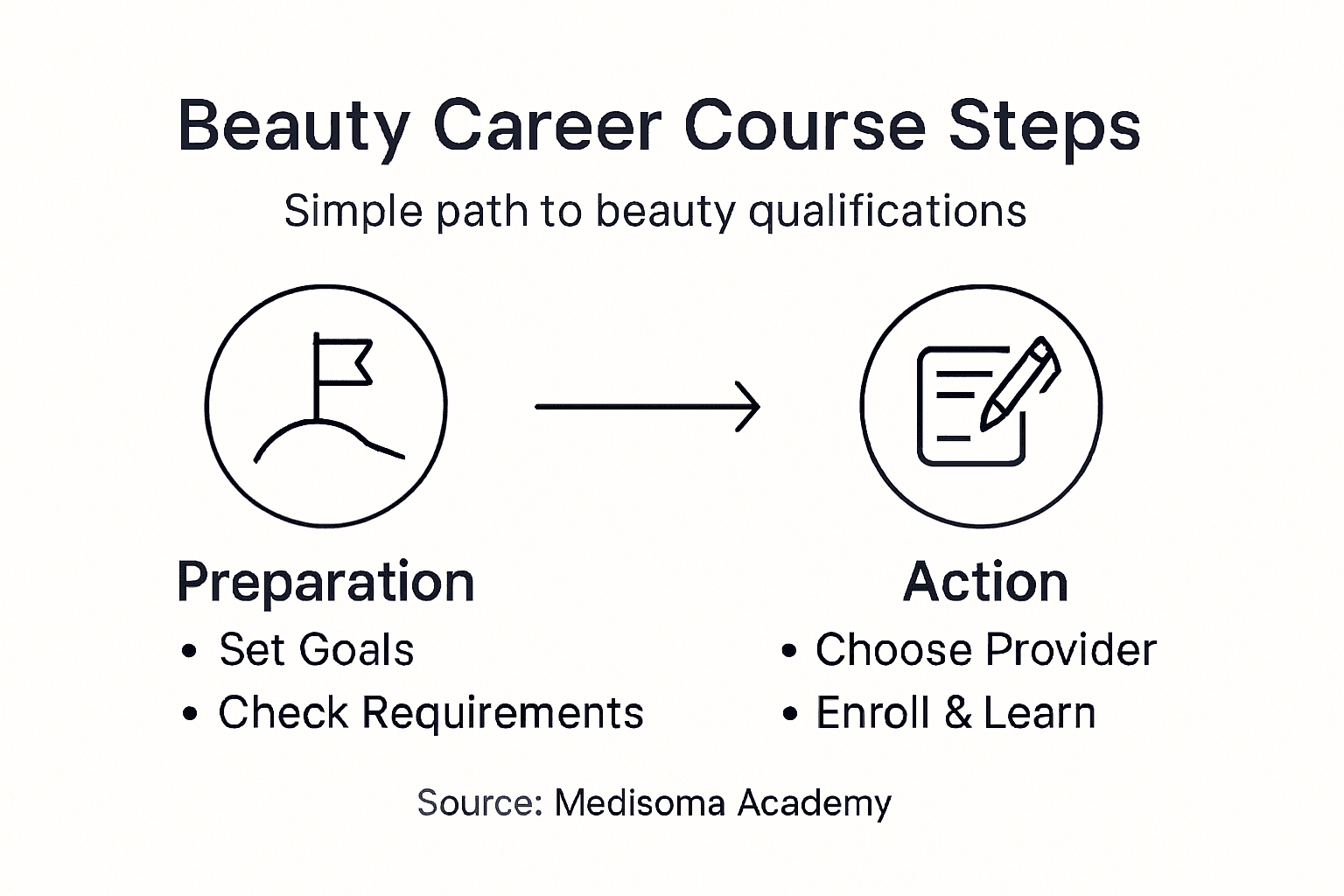
Align your personal goals with course content by reviewing the syllabus carefully. Does the course structure match how you want to develop your skills? If you dream of working with premium skincare brands, a course heavy in makeup artistry might leave you feeling unfulfilled. Check whether the qualification holds industry recognition through bodies like VTCT, as this accreditation opens doors with employers and clients alike. Consider practical factors too. Can you attend during the course schedule offered? Will a fast track intensive suit your learning style, or do you prefer a more gradual pace? Your commitment to the course increases dramatically when the timing and structure fit your lifestyle and learning preferences.
Professional tip Write down your top three career goals for beauty therapy alongside the entry requirements for your shortlisted courses, then compare them side by side to spot where your ambitions and the course offerings truly connect.
Step 3: Select the best course provider for your needs
Choosing the right course provider matters as much as choosing the course itself. Your training quality, support experience, and career outcomes all depend on the academy you select. This step requires you to evaluate potential providers against your specific priorities and learning style.
Begin by researching the academy’s credentials and reputation. Check whether they hold accreditation from recognised bodies. VTCT certification demonstrates that a provider meets strict industry standards for curriculum quality, teaching expertise, and student support. Read reviews from past students on their websites and social media platforms. Look for consistent feedback about teaching quality, hands on experience, and job placement support. Don’t just skim surface level comments. Dig deeper. What do people say about the instructors? How much practical training do students actually receive? Do graduates feel confident entering the workplace? These details reveal whether an academy truly delivers on its promises.
Next, assess the practical elements of each provider. Visit their facilities if possible or request virtual tours. Observe the training environment, equipment quality, and class sizes. Smaller class sizes typically mean more individual attention from instructors and better access to practice opportunities. Ask about their teaching approach. Do they combine theory with plenty of hands on practice? Beauty therapy requires muscle memory and real world application. A course heavy on lectures but light on practical work leaves you underprepared for clients. Investigate what happens after you graduate. Does the academy offer job placement assistance? Do they maintain connections with salons and spas? Some providers offer ongoing support networks or alumni communities that help you build your career long after coursework ends.
Consider the course structure and flexibility alongside your personal circumstances. Some providers offer fast track intensive programmes that compress learning into shorter timeframes, whilst others spread content across longer periods. Think about your current commitments. Can you dedicate full time hours to study? Do you need evening or weekend classes? Ask about support services too. Do they offer additional help for struggling students? What about career guidance or business advice if you plan to work independently? The best provider isn’t necessarily the most prestigious or the most affordable. It’s the one that aligns your learning style, schedule, and goals whilst providing quality instruction from experienced professionals.
The following table summarises the support you might receive from course providers during your beauty therapy training:
| Support Type | Typical Availability | Impact on Students |
|---|---|---|
| Job Placement Assistance | Offered by leading academies | Increases employability post-graduation |
| Practical Training Hours | Required in accredited courses | Enhances real-world skills and confidence |
| Alumni Network | Provided by some institutions | Aids long-term career growth and networking |
| Flexible Payment Plans | Common feature | Makes training more financially accessible |
Professional tip Contact at least three providers, ask identical questions about their teaching methods and graduate outcomes, then compare their responses side by side to spot which academy demonstrates genuine knowledge and commitment to student success.
Step 4: Enrol and participate in the chosen course
Now that you have selected your course provider, it is time to complete the enrolment process and commit to your beauty therapy training. This step transforms your planning into action, marking the beginning of your professional development journey.

Start the enrolment process by contacting the academy directly or completing their online application form. You will typically need to provide personal details, educational background, and confirmation that you meet their entry requirements. Be thorough and accurate with your application. Any discrepancies can delay processing. Ask about payment options and timelines. Most providers offer flexible payment plans alongside full upfront payments, so explore what works for your finances. Confirm what happens next. When does the course begin? What documents should you bring on your first day? Will you receive a welcome pack or pre course materials? Understanding the practical logistics removes stress and allows you to prepare mentally and physically for the training ahead.
Before your course starts, gather any required materials and equipment. Many beauty therapy courses require specific items like beauty therapy uniforms, closed toe shoes, and personal protective equipment. Some academies provide these, whilst others expect you to purchase them independently. Check your enrolment paperwork or ask directly. Prepare your mindset too. Beauty therapy training demands focus, dedication, and willingness to practise techniques repeatedly. You will work with real clients during many courses, so mental preparation matters. Read any pre course materials sent by your academy. Familiarise yourself with the curriculum, learning outcomes, and assessment methods. This background knowledge helps you hit the ground running on day one rather than feeling overwhelmed by new information.
When the course begins, engage fully from the first session. Arrive early, participate actively in discussions, and ask questions when you do not understand something. Building strong relationships with your instructors and classmates creates a supportive learning environment. Attend every session unless genuinely unable to do so. Consistency matters in hands on training like beauty therapy. Missed lessons mean missed practice opportunities, and you cannot develop competency in facial electrotherapy or anatomy without regular practice. Take detailed notes during theory sessions and practical demonstrations. Write down techniques, product information, and safety protocols. These notes become invaluable reference materials when practising at home or reviewing before assessments. Many students find that taking their own photographs or videos of demonstrated techniques helps embed learning, so check whether your academy permits this.
Participate actively in practical sessions and assessments. Beauty therapy requires confidence, and confidence comes from repeated practice in a safe environment. Do not worry about making mistakes during training. That is precisely why you are in the classroom. Ask your instructors for feedback regularly. Constructive criticism helps you improve faster than assuming you are performing correctly. Seek out peer practice opportunities outside formal sessions if possible. Practising on classmates or friends builds your speed and confidence with techniques. Connect with your cohort genuinely. Your classmates are experiencing the same challenges and excitement as you, and they become your professional network long after the course ends.
Professional tip Set specific learning goals for each week of your course and review them with your instructor monthly, adjusting focus areas based on feedback to maximise your development in weaker areas.
Step 5: Verify accreditation and your achieved qualifications
As you near the end of your beauty therapy course, verifying that your qualification holds genuine industry recognition becomes critical. This step ensures your hard work translates into credentials that employers and clients actually value in the competitive beauty market.
Understand what accreditation means for your career prospects. Accreditation is not simply a certificate hanging on a wall. It is formal recognition from respected industry bodies that your training meets established standards for knowledge, practical skill, and professional conduct. When you complete a course accredited by recognised awarding bodies, employers know exactly what competencies you possess without needing to assess you further. Clients trust that you have received quality training meeting industry benchmarks. This recognition opens doors that unaccredited qualifications cannot. Before your course ends, confirm with your academy which awarding bodies have accredited your specific qualification. Ask whether your course is accredited through VTCT, City and Guilds, or other recognised bodies. Request written confirmation of the accreditation level and scope. Different levels carry different weight in the job market. A Level 3 qualification typically carries more professional standing than Level 2, for example, and employers often prefer candidates with higher level credentials.
Once you complete your course, carefully review your final certificate when it arrives. Check that your name, the qualification title, accreditation body, achievement date, and grade are all correct. Mistakes on certificates can complicate job applications or further training opportunities, so report any errors to your academy immediately for correction. Understand your qualification scope. What specific areas of beauty therapy does your qualification cover? Does it include facial treatments, body treatments, nail services, or a combination? This scope matters because employers often look for candidates whose qualifications match their salon’s specific focus. If your certificate shows gaps in areas you want to work with, you might consider additional training through CPD continuing professional development courses to enhance your marketability.
Verify your qualification through official channels. Most awarding bodies maintain online registers where you can check whether a qualification genuinely exists and is properly accredited. This verification protects you from fraud and demonstrates your commitment to legitimate credentials. Keep your original certificate in a safe place and consider obtaining certified copies for job applications. When applying for beauty therapy positions, never understate your qualifications. Be clear about your accreditation level and awarding body. Employers in the UK recognise VTCT and City and Guilds certifications immediately, which strengthens your candidacy significantly. If you plan to work abroad or continue studying, research whether your UK accreditation transfers internationally. Some countries recognise UK beauty therapy qualifications, whilst others require additional certification or conversion courses. Understanding this early allows you to plan your career trajectory confidently.
Here is a comparison of major beauty therapy qualification accrediting bodies and their key features:
| Accrediting Body | Recognition Scope | Typical Qualification Levels | Employer Perception |
|---|---|---|---|
| VTCT | UK and international | Levels 2, 3, 4 | Highly regarded in salons |
| City and Guilds | UK-wide | Levels 2, 3 | Trusted, broad acceptance |
| CIBTAC | International | Levels 2, 3, 4 | Preferred for global roles |
| ITEC | International | Levels 2, 3 | Recognised in many countries |
Professional tip Create a digital portfolio containing photographs of your original certificate, proof of accreditation verification from the awarding body website, and testimonials from clients you treated during your training, as this comprehensive evidence significantly strengthens job applications and builds client confidence in your credentials.
Accelerate Your Beauty Therapy Career with Medisoma Academy
Starting your journey with accredited beauty therapy courses requires not only dedication but access to expert guidance and supportive training environments. The article highlights challenges like selecting the right accredited course, understanding entry requirements, and verifying qualifications for genuine industry recognition. These hurdles can be overwhelming when trying to align your personal goals with quality training that prepares you for success.
At Medisoma Academy, we understand these pains and offer fast track, accredited courses designed to build your confidence and expertise efficiently. Our programmes are crafted to promote self-esteem, encourage creativity, and deliver excellence, ensuring you gain both practical skills and recognised qualifications. Discover how we support your growth with personalised teaching and valuable industry insights through our Growing – Medisoma resources.
Ready to step confidently into a rewarding beauty career? Explore our comprehensive courses and join a community that values your ambitions and fosters your professional development. Visit Medisoma Academy today to find the perfect accredited course tailored for your future. Don’t miss out on expert advice and practical training that transforms your passion into a thriving profession. For insights on building your business and attracting clients, check out our Marketing – Medisoma and learn how to turn your skills into a successful career through Monetizing – Medisoma.
Frequently Asked Questions
What entry requirements should I consider for beauty therapy courses?
Most accredited beauty therapy programmes require you to be at least 16 years old and have a reasonable educational background, such as GCSEs or equivalent. Research each course provider’s specific requirements to ensure you meet them before applying.
How do I select the best course provider for my beauty therapy training?
Evaluate potential course providers by checking their credentials, student reviews, and practical training opportunities. Visit their facilities if possible to observe the learning environment and ensure it aligns with your needs and goals.
What should I do to prepare before starting my beauty therapy course?
Gather any required materials, such as uniforms and equipment, and review pre-course materials sent by the academy. Familiarising yourself with the curriculum will help you feel prepared and confident on the first day of training.
How can I verify the accreditation of my beauty therapy qualification?
Confirm with your course provider which awarding bodies have accredited your qualification before completing the course. Additionally, check online registers of the relevant bodies to ensure your qualification holds industry recognition.
What steps can I take if I wish to specialise in a specific area of beauty therapy?
Start by reflecting on your career goals and researching which beauty therapy courses focus on your area of interest, such as skincare or nail artistry. Make sure to select a course that aligns with your aspirations for the best training experience.
How do I ensure my qualification is valued by employers?
Verify that your qualification is accredited by recognised bodies like VTCT or City and Guilds, as this enhances your employability. Keep your original certificate safe and consider obtaining certified copies for job applications to showcase your credentials effectively.